Buying a Cheap Drift Car in the UK: Inspection Checklist
A cheap drift car in the UK is rarely a cheap car by the time you have finished with it. The real danger is buying someone else's abandoned project: a shell with rot around the subframe mounts, a turbo that smokes, and a boot full of parts that do not fit. None of that shows up in a photo.
The good news is that most of it shows up in twenty minutes with a torch, a screwdriver and a piece of cardboard to lie on. Here is what to check, roughly in the order that matters.
Do the paperwork checks before you travel
Start at the DVLA's MOT history service on gov.uk. It is free and it takes two minutes. You are looking for two things: the pattern of advisories, and any gap in the mileage that does not add up.
Repeated advisories for corrosion, brake pipes, or "suspension component mounting prescribed area" tell you exactly where the car is going. A car with years of corrosion advisories followed by a fresh MOT with a clean sheet the week before the sale deserves questions: who did the welding, where, and can you see it? A long gap with no MOT usually means the car sat outside, unused, quietly rusting.
Message the seller before you set off and ask:
- Is the V5C in your name, at your address?
- Has it ever been welded, and can you send photos of the repairs?
- Will you leave it cold so I can hear it start from cold?
Anyone who refuses the third question is hiding something. A warm engine starts easily and hides rattle, smoke and rough running.
Rust is the deciding factor
Mechanical parts unbolt. Rust does not. On a UK car, the metal decides whether you are buying a project or a money pit.
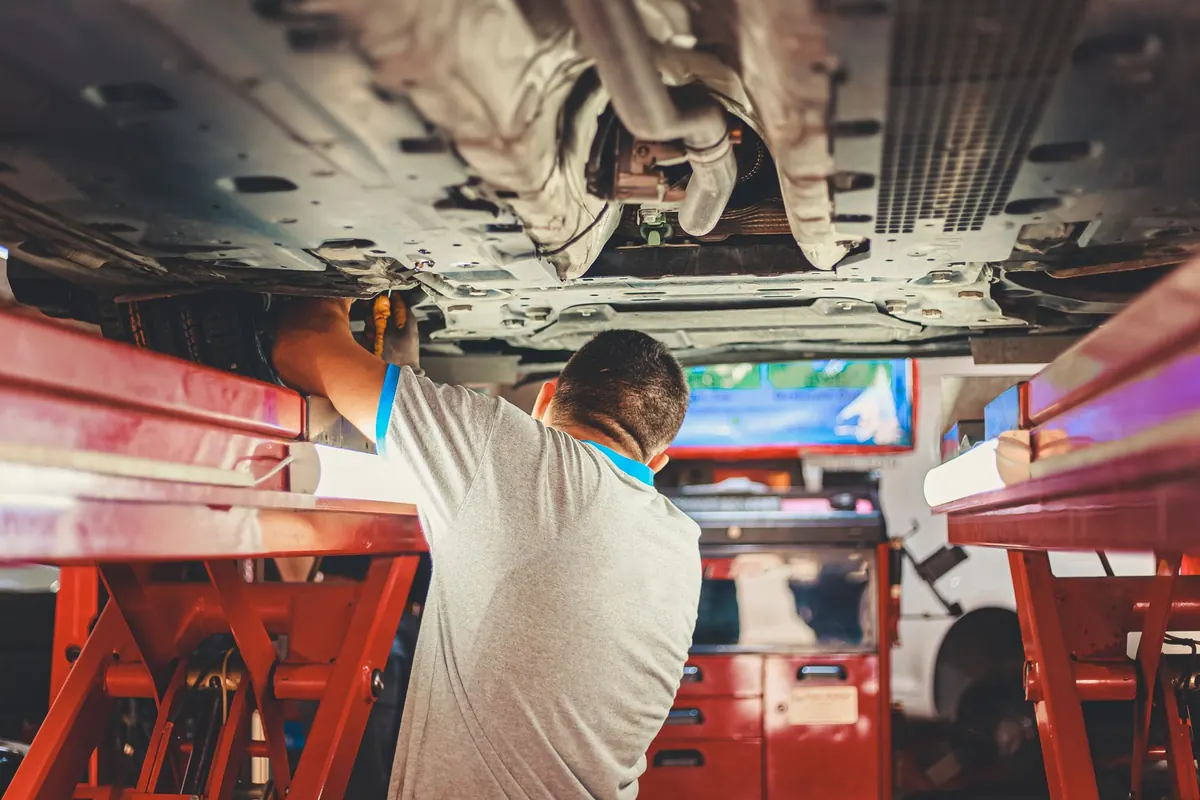
Get underneath with a torch and press hard with a screwdriver — not to stab holes in someone's car, but to test anything that looks soft, bubbly or freshly undersealed. Be systematic:
- Sills and jacking points — outer sill, then the inner sill behind it. Feel along the full length.
- Floorpan and seat mounts — especially where the seat rails and harness eye bolts land.
- Rear subframe mounting points — the single most important area on most rear-drive cars.
- Strut towers and inner wings — front and rear, under the bonnet and in the boot.
- Boot floor and spare wheel well — a common hiding place for water and rot.
- Brake and fuel lines — if they are crusty, budget for replacing all of them.
- Rear arches and arch liners — pull the liner back and look properly.
Underseal sprayed over rust is easy to spot: it is tacky, uneven, and often fresher than the rest of the car. A magnet is useful, but it will not stick to filler or fibreglass, so a magnet that refuses to grip is a warning, not proof.
Welding is not automatically a dealbreaker. A properly plated and seam-sealed repair is normal on a twenty-year-old car. What you want to avoid is a patch over a hole with rot still creeping out from the edges.
Suspension, steering and the bits drifting destroys
Jack each front corner up and grab the wheel at twelve and six o'clock, then three and nine. Any clunk or movement means wheel bearings, ball joints, track rod ends or top mounts. Worn bushes are normal, but perished subframe bushes and rose joints with play are consumables you will be buying soon.
Look at the coilovers: leaking dampers, cracked springs, seized adjusters and mismatched brands on each corner all suggest a car assembled from whatever was lying around. Check the steering wheel sits straight when driving in a line — if it does not, the car may have taken a knock.
Then the drift-specific hardware. A welded diff will clunk and scrub the rear tyres on tight turns; that is expected, but listen for a whine that rises with speed, which points to a tired diff. If there is a hydraulic handbrake, check the lines for leaks and the lever for a solid feel. Test the clutch with a few high-rev changes — second and third gear synchros are usually the first to suffer from clutch kicks.
Engine and drivetrain health
Hear it cold. Listen for a rattle on start-up that fades after a second or two (timing chain, on some engines), then a steady tappety noise that does not go away (lifters). Blue smoke on boost or on the overrun suggests turbo seals or worn rings. White smoke and a sweet smell means coolant is going somewhere it should not.
Check the oil on the dipstick: milky means head gasket trouble, black and gritty means neglect. Look at the coolant in the expansion tank with the engine cold. Then check for leaks underneath — rear main seal, sump, rocker cover and gearbox output seal are all common.
Wiring is where cheap builds fall apart. Aftermarket boost controllers, gauges and immobilisers should be soldered and heat-shrunk, not twisted together and taped. Look at the ECU area for cut looms.
Model-specific things to know
- Mazda MX-5 (NA/NB): sills, rear arches and, on the NB, the front chassis rails. Modest power, brilliant to learn in.
- BMW E36/E46: rear subframe mounting points on the boot floor, cooling systems, and rust in the arches and jacking pads.
- Nissan 200SX and Skyline: imports are often better underneath but check the conversion paperwork; SR20 and CA18 engines are old now, so expect tired turbos and big-end wear.
- Nissan 350Z: heavy, thirsty, rusty rear subframes and a known appetite for oil on some engines.
- Older classics: lovely when solid, painful when parts are rare and expensive.
Whatever you choose, pick a car with a big aftermarket and cheap consumables. You will be buying a lot of tyres, pads and bushes.
Reasons to walk away
No V5C in the seller's name. A subframe mount that has been plated over rot. Cut springs. Frame damage disguised by fresh paint on one rear quarter. A seller who will not let you jack the car up or bring a friend who knows the model. And any car with no MOT that "just needs a bit of work" — that phrase has bankrupted more drifters than kerbs have.
If you are spending serious money, a paid pre-purchase inspection by a specialist is good value. And for anything involving road legality, insurance or track-day rules, speak to your insurer or a specialist broker rather than trusting a forum post.
Budget beyond the purchase price
Assume you will need a spare set of wheels with part-worn tyres, brake pads and fluid, a service kit, a battery, and welding if the MOT advisories were honest. Add a helmet, a seat you fit in properly, and entry fees for practice days. Keep a few hundred pounds aside for the first thing that breaks, because it will break on your first outing.
A car that starts cold, stops straight, steers true and has solid metal will take you much further than a rough-looking bargain with a good engine. Take the torch, take the cardboard, and buy with your hands rather than your heart.
Photo: Enis Yavuz / Pexels